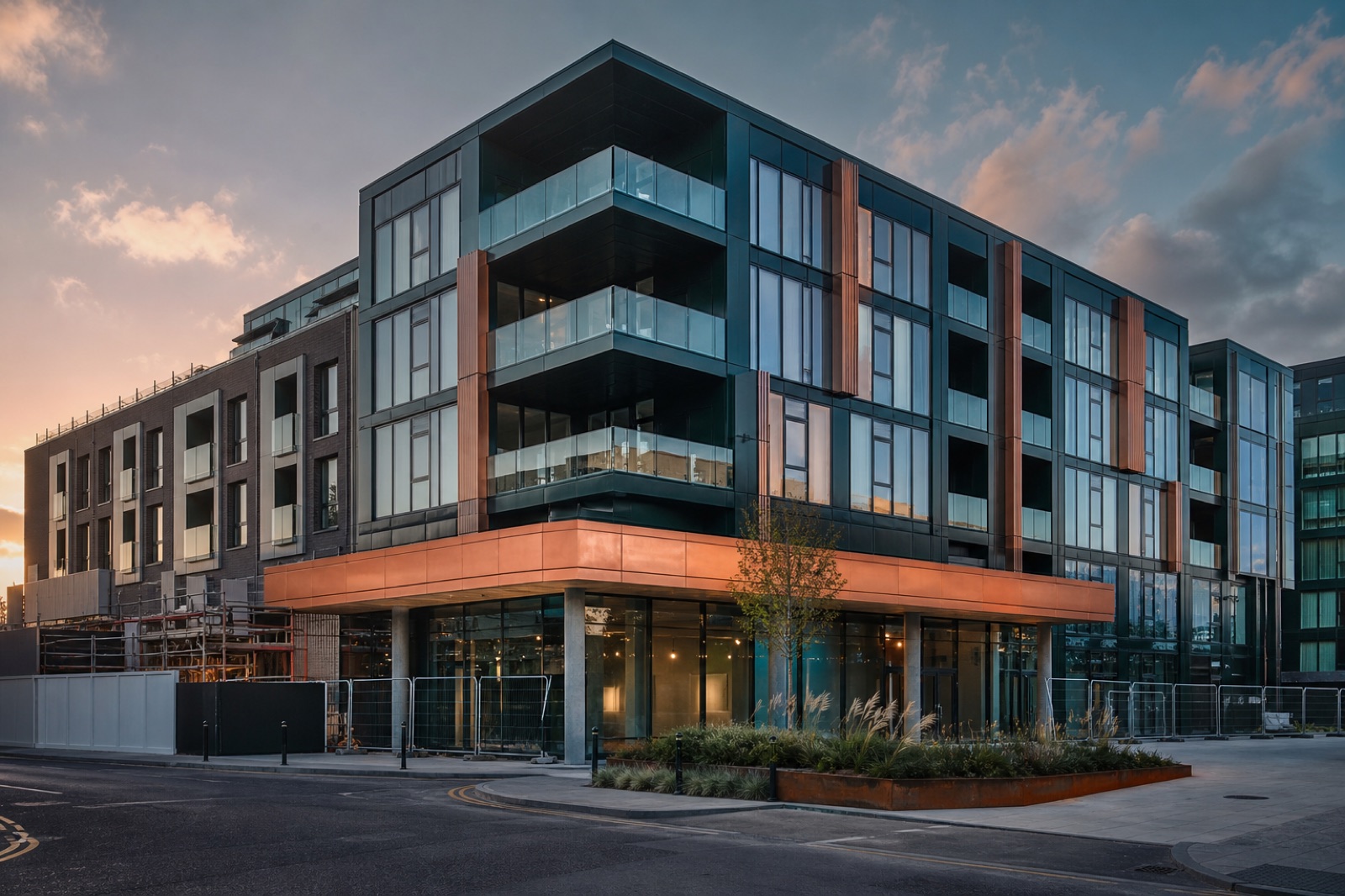
Exit funding for completed apartment blocks
The facility that repays development finance on a completed block of flats at practical completion, then funds the marketing period while the units sell across the scheme. Residential development exit finance replaces construction-priced debt with a cheaper, value-led bridging loan once the build risk is gone, and removes the pressure of a maturing development loan while the apartments are sold or let. We arrange and place it with specialist bridging lenders and debt funds active in completed residential schemes.

What is a development exit bridge on an apartment scheme?
Residential development exit finance is a bridging loan arranged once a residential apartment scheme reaches practical completion (PC), used to repay the existing development finance facility. The development loan was priced for construction risk: the risk that the block ran over budget, fell behind programme, or failed to complete. Once the apartments are finished and signed off, that risk is gone, but the development facility is often expensive and close to its maturity date. A development exit bridge refinances it onto cheaper, short-term property finance and gives the developer the months needed to sell the units across the block, rather than being forced into a discounted bulk sale to repay a development loan that has run out of road.
On a completed residential scheme this is the most-used structure in development finance, because almost every block reaches a point where the build is done but the sales are not. A property developer typically needs a sales period of several months to market and complete on the last apartments in a block, and the development loan is the wrong debt to carry that period. The exit facility is secured by a first legal charge over the completed scheme and sized against its gross development value (GDV), the day-one value of the finished block, rather than its build cost. Because it is valued on completion, the loan-to-value (LTV) available is often higher than the development loan being repaid, which can release capital above the senior debt for the developer to put into the next site.
We are a finance arranger and introducer, not a lender, and we are not FCA-authorised. We place residential development exit finance with specialist bridging lenders and debt funds that publicly operate in development exit and bridging finance, including the specialist lenders and debt funds that fund finished schemes and the wider bridging market, without claiming any of them as a fixed panel. We line up the longer-term exit strategy at the same time, whether that is unit sales across the block, a refinance onto buy-to-let or investment term debt on any apartments retained, or a residual stock loan against the last unsold units. All terms are illustrative, subject to principal sign-off, and not an offer of finance.
- Repays the existing development finance facility once the block reaches practical completion
- Replaces construction-priced debt with a lower-rate bridging loan now the build risk is gone
- Sized on gross development value (GDV), the completed scheme's day-one value, not build cost
- Funds the sales and marketing period while the apartments are sold across the block
- Can release capital above the senior debt repaid for the developer's next scheme
- Placed with specialist bridging lenders and debt funds active in completed residential schemes
Indicative terms
- Loan to value (LTV)Indicatively up to 70 to 75 percent of GDV, the completed block's day-one value
- GDV basisSized on gross development value, the finished scheme's open-market value, not build cost
- Term12 to 18 months, covering the sales and marketing period
- RateIndicatively around 0.65 to 0.95 percent per month, illustrative, below the development loan it replaces
- RepaymentInterest retained or rolled up, serviced where rental income allows
- SecurityFirst legal charge over the completed residential apartment scheme
- Key testsPractical completion, the sales rate, residual stock, the exit strategy
- ExitNet unit sales across the block, refinance onto term debt, or a residual stock loan
Indicative only. Terms vary by lender, scheme and borrower and are not an offer of finance.
Who it suits
- Property developers whose development finance is maturing before the block has sold
- Housebuilders marketing the final apartments on a completed residential scheme
- Developers wanting to release capital from a finished block to fund the next site
- Borrowers refinancing off expensive development finance onto a lower-rate facility
- Developers left holding residual stock, the last unsold units across the block
Discuss your scheme
A view on fundability within one working day.
How the exit facility works across the block
Confirm practical completion and value the block
We confirm the scheme has reached practical completion, with building control sign-off and warranties in place, and value the finished block on its gross development value rather than its build cost.
Repay the development finance
We arrange a development exit bridge that repays the existing development loan in full as a single drawdown, usually at a lower rate, and term it to cover the sales period across the block.
Fund the sales and marketing period
The developer markets and sells the apartments without the pressure of a maturing development loan, and can release capital above the senior debt at the same time.
Repay on unit sales or refinance
The bridge is repaid as net sales come in unit by unit, or on a refinance onto investment term debt, or by a residual stock loan against the last unsold flats.
Criteria for a finished-scheme bridge
Development exit lenders are most comfortable once an apartment scheme has reached practical completion, because the construction risk that drove the development finance has been removed. They want sight of the completion certificate, building control sign-off, the structural warranty and the NHBC or equivalent cover on each unit, an open-market valuation of the finished block, and a credible plan to repay: a sales programme with realistic pricing and an absorption rate the local market supports. They will assess the property developer's experience, but they are underwriting a finished, saleable block of flats rather than years of trading, so a developer on an early scheme is fundable where the apartments are genuinely complete and the exit is sound. They look closely at the sales rate and the depth of demand for the unit mix, because the repayment comes from net sales across the block over the marketing period. We confirm and document the exit before the facility draws, so the bridge is repaid on schedule rather than rolled repeatedly.
How much sales-period funding you can raise
Residential development exit finance is sized against the gross development value of the completed block, indicatively up to 70 to 75 percent of value, which is often higher than the development loan being repaid because the apartments are now finished and valued on completion rather than on cost. That headroom can release capital above the senior debt for the developer to deploy on the next site. The facility runs for the sales period, typically 12 to 18 months, with interest usually retained or rolled up so the net day-one advance is the gross loan less the retained interest and fees, and so monthly cash flow is not strained while the units are still selling. As apartments sell, each net sale makes a partial repayment and the lender releases that unit from its charge, so the facility winds down across the block. We model the loan against GDV, the capital it releases and the all-in cost over the expected sales period before approaching lenders. All bands are illustrative, vary by lender and scheme, are subject to principal sign-off, and are not an offer.
What an apartment block exit loan costs
The point of moving onto a development exit bridge is the saving: refinancing off development finance priced for construction risk onto short-term property finance priced for a finished block usually cuts the monthly cost, while removing the maturity pressure that forces a discounted bulk sale. Indicative pricing sits around 0.65 to 0.95 percent per month, illustrative only and not an offer, with interest usually retained or rolled up rather than serviced. On top of the rate, expect a lender arrangement fee of indicatively around 1 to 2 percent, a valuation, legal costs for both sides, and sometimes an exit fee. The largest cost lever is time: a bridge held for four months costs a fraction of one held for eighteen, so a realistic sales plan and a clean exit matter more than chasing the lowest headline rate per month. We disclose our broker fee in writing, quote the all-in cost over the expected term, and never claim an exclusive panel or fabricate lender numbers. The figures are indicative and not an offer of finance.
A developer exit loan against the development facility
A developer exit loan and the development finance it replaces do different jobs at different points in the scheme. Development finance is the right debt while the block is being built, because it funds construction and is priced for the risk that the build runs over or fails to complete. Once practical completion is reached that risk is gone, so keeping the asset on development finance means paying construction-risk pricing and extension fees on a facility that may be past its term, which is exactly why a development exit bridge lowers the cost. Where the developer intends to sell the whole block, the exit bridge holds the asset through the sales period and is repaid on net sales. Where some apartments are retained and let, the route is often a development exit bridge first, then a refinance onto buy-to-let or investment term debt, or a residual stock loan against the last unsold units. We map the route so the block is on the right debt for what it is about to do.
Residential apartment schemes: common questions
What is residential development exit finance and how does it work?
Residential development exit finance is a bridging loan arranged once an apartment scheme reaches practical completion, used to repay the existing development finance facility. It refinances construction-priced debt onto a lower-rate bridge, removes the pressure of a maturing development loan, and funds the marketing period while the units sell across the block. It can also release capital above the senior debt being repaid, which the developer can put into the next site. We arrange and place the facility and line up the exit at the same time.
How much does development exit finance cost in rates and fees?
Indicative pricing is around 0.65 to 0.95 percent per month, illustrative only and not an offer, with interest usually retained or rolled up rather than serviced. On top of the rate, expect a lender arrangement fee of indicatively around 1 to 2 percent, a valuation, legal costs for both sides and sometimes an exit fee. The biggest driver of the total cost is time, so a short, realistic sales period costs far less than a bridge held to its full term. The figures are illustrative and subject to principal sign-off.
Can I arrange exit finance before or at practical completion on an apartment block?
Yes. Lenders are most comfortable at or just after practical completion, once building control sign-off and warranties are in place, because the construction risk has gone. Many will agree terms in principle before practical completion so the exit facility is ready to draw the moment the block completes and the development loan falls due, which avoids slipping onto extension fees. We line the facility up ahead of completion so the senior debt repayment happens cleanly on the day. The terms are indicative and subject to principal sign-off.
What LTV and loan size can I get against a completed apartment scheme?
Indicatively up to 70 to 75 percent of gross development value, the day-one value of the completed block, which is often more than the development loan being repaid because the apartments are now valued on completion rather than on cost. Loan sizes typically run from around 500,000 pounds to several million on a larger scheme. The headroom above the senior debt can be released as capital. The figures are illustrative, vary by lender and scheme, and are subject to principal sign-off.
How does exit finance fund the sales period while the flats are still selling?
The exit facility is termed to cover the sales period, typically 12 to 18 months, with interest retained or rolled up so monthly cash flow is not strained while the apartments are still on the market. As each unit sells, the net sale proceeds make a partial repayment and the lender releases that apartment from its charge, so the loan winds down across the block. This gives the developer time to achieve full prices unit by unit rather than discounting the whole block for a quick bulk sale.
How do I refinance and repay my existing development loan at practical completion?
We arrange a development exit bridge secured by a first legal charge over the completed block, sized on its gross development value, that repays the existing development loan in full as a single drawdown at practical completion. The development lender is redeemed, the senior debt repayment is made, and the asset moves onto the cheaper exit facility for the sales period. We confirm the exit, whether unit sales, an investment refinance or a residual stock loan, before the facility draws, so the bridge has a clear destination. The figures are indicative and not an offer of finance.
Funding a completed residential apartment schemes scheme?
Send us the scheme and where it has reached, and we will come back with a view on fundability and likely terms within one working day.