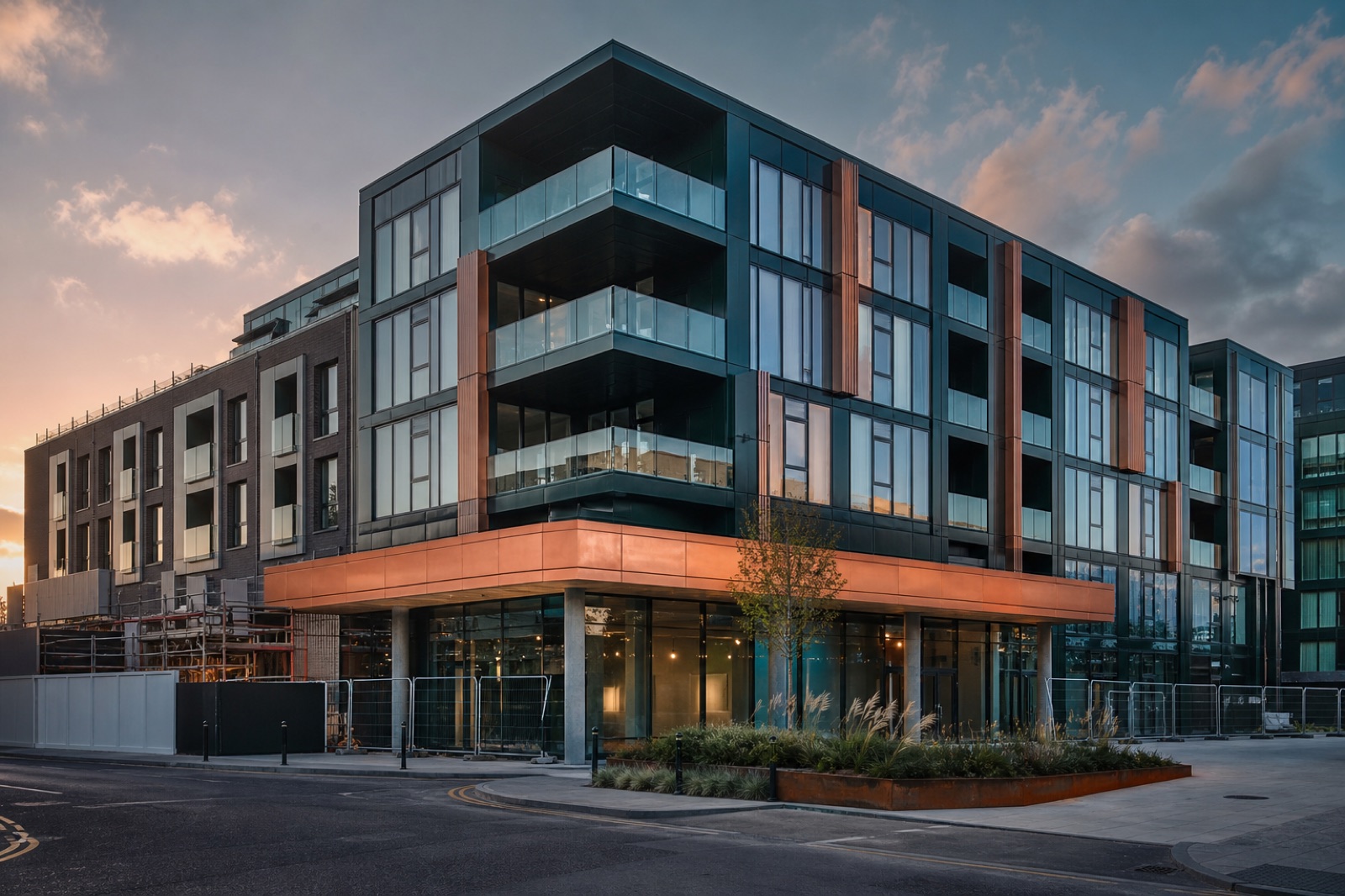
Development exit finance for mixed-use schemes
The facility that repays a development loan on a completed mixed-use scheme at practical completion, lowers the cost of capital, and bridges the differing sales and letting timelines of the residential and commercial elements. We arrange and place development exit finance for residential over commercial buildings once the build risk is gone, holding the flats through their sales window while the ground-floor commercial unit is let. DevExit is an arranger and introducer, not a lender.

What a mixed-use development exit bridge does
Mixed-use development exit finance is a bridging loan used once a mixed-use scheme reaches practical completion, arranged to repay the existing development finance facility. Property development finance is priced for construction risk: the risk that the build runs over budget or behind programme, or does not complete. Once the residential flats over the ground-floor commercial unit are finished and signed off, that risk is gone, but the senior debt behind the build is often expensive and close to its maturity date. A development exit bridge refinances that development loan onto cheaper terms and funds the period while the two elements sell and let, so the developer is not forced into a discounted sale to repay a facility that has run out of road.
The defining feature of a mixed-use scheme is that the residential element and the commercial element move on different timelines. The flats sell into an owner-occupier or buy-to-let market over a defined sales window, and complete one by one. The ground-floor commercial unit, the shop, office or sui generis space within Use Class E, lets to an occupier on a commercial lease, and that lease-up can take longer than the residential sales. A development exit bridge is sized and termed to span both, so the residential sales period and the commercial letting period are funded under one facility rather than two disconnected deals. Where the building can be split, a title split between the residential flats and the commercial unit lets each part sell or refinance on its own basis. The bridge is secured by a first legal charge over the completed scheme and sized against its gross development value (GDV), the day-one value of the finished asset, rather than against build cost.
We are arrangers, not a lender. We place mixed-use development exit finance with the specialist bridging lenders and debt funds that publicly operate in development exit and mixed-use lending, alongside the wider market of specialist development and bridging lenders, challenger banks and debt funds. We line up the longer-term exit at the same time, whether that is residential unit sales, a commercial investment refinance once the unit is let, or a held position on an investment mortgage across the let scheme. All terms are illustrative, subject to principal sign-off, and not an offer of finance.
- Repays the development finance facility once the mixed-use scheme reaches practical completion
- Lowers the cost of capital by removing construction-risk pricing from a finished residential over commercial building
- Bridges the differing sales window for the flats and the commercial letting timeline for the ground-floor unit
- Sized on gross development value (GDV) and a loan to GDV basis, not on build cost
- Supports a title split so the residential element and commercial element can sell or refinance separately
- Placed with specialist bridging lenders and debt funds active in mixed-use development exit
Indicative terms
- Gross development valueSized on mixed-use GDV, the day-one value of the finished residential and commercial elements
- Loan to value / loan to GDVIndicatively up to 70 to 75 percent of value on a finished scheme
- TermMonths not years, typically 12 to 18 months across the sales window and commercial lease-up
- RateIndicatively below the development finance it replaces, priced per month or per year
- InterestUsually retained or rolled up, serviced where some rental income is already in place
- RepaymentReduces on residential unit sales, on a commercial investment refinance, or on a let-and-sold disposal
- Key testsPractical completion, the sales and letting plan, commercial lease and covenant, the exit
- ExitResidential sell-down, commercial letting then investment refinance, or a let scheme held on an investment mortgage
Indicative only. Terms vary by lender, scheme and borrower and are not an offer of finance.
Who it suits
- Developers whose mixed-use development finance is maturing before the flats sell and the unit lets
- Developers of residential over commercial schemes with a slower commercial letting timeline
- Borrowers marketing the residential flats while the ground-floor commercial unit is still unlet
- Developers wanting to release surplus equity above the development loan to start the next scheme
- First-time developers refinancing off expensive construction-priced debt onto sales-period funding
Discuss your scheme
A view on fundability within one working day.
How sales-period funding works on a finished mixed-use scheme
Confirm practical completion
We confirm the scheme is complete with building control sign-off and warranties in place, then value the finished residential and commercial elements on their gross development value rather than build cost.
Repay the development loan
We arrange a development exit bridge that repays the senior development finance facility, usually at a lower rate, and term it to cover both the residential sales window and the commercial lease-up.
Sell the flats and let the unit
The developer markets and completes on the residential units while the ground-floor commercial unit lets, with interest usually retained or rolled up so cash flow is not strained while the two elements move at different speeds.
Exit on sales or refinance
The bridge reduces as flats sell and is repaid in full on the final sale, on a commercial investment refinance once the unit is let, or by an investment mortgage across the let-and-sold scheme.
Criteria for a residential over commercial exit facility
Mixed-use development exit lenders are most comfortable once a scheme has reached practical completion, because the construction risk that drove the development finance has been removed. They want sight of the completion certificate, building control sign-off, structural warranties and any collateral warranties, a valuation of the finished residential and commercial elements, and a credible plan to repay. On a mixed-use building that plan has two parts: a realistic residential sales programme with sensible pricing and absorption across the sales window, and a letting strategy for the ground-floor commercial unit, including whether the space sits within Use Class E or is sui generis, any agreement for lease, the strength of the tenant covenant and the unexpired term. Lenders look closely at the commercial element, because its slower letting timeline drives how long the facility runs. A part-let or pre-let scheme is straightforward to fund; a scheme where the flats are ready but the commercial unit is empty is fundable but assessed harder on the local occupier market and the open market value (OMV) of the let space. They will weigh the developer's experience, but they are underwriting a finished, financeable asset and its sales and income, not years of trading, so first-time developers are fundable where the scheme is genuinely complete and the exit is sound. We document the sales plan, the lease position and the exit before the exit facility draws, so the bridge does its job and is repaid on time rather than rolled repeatedly.
How much the exit funding advances on mixed-use GDV
Mixed-use development exit finance is sized against the gross development value of the completed scheme on a loan to GDV basis, indicatively up to 70 to 75 percent of value (LTV), with the band reflecting how much of the GDV sits in the residential element against the commercial element and how far the commercial unit is let. That figure is often higher than the development loan being repaid, because the asset is now valued on completion rather than on cost, and the headroom can release surplus equity for the developer to put into the next scheme. Pricing is lower than the mixed-use development finance it replaces, because the build risk is gone, and is set per month or per year depending on the lender and the length of the facility. Interest is usually retained or rolled up, so the net day-one advance is the gross loan less retained interest and fees, with serviced interest an option where some rental income is already flowing from a let unit. Where the building carries a title split, the residential flats and the commercial unit can be valued and geared on their own basis, which sometimes lifts the overall advance. We model the loan against GDV, the equity it releases and the all-in cost over the expected sales and letting period before approaching lenders. All bands are illustrative, vary by lender, asset and scheme, are subject to principal sign-off, and are not an offer.
What a finished-scheme bridge costs against mixed-use development debt
The point of mixed-use development exit finance is the saving: refinancing off senior development debt priced for construction risk onto a bridge priced for a finished scheme usually cuts the monthly cost materially, while removing the maturity pressure that forces a discounted sale of the flats before the market is ready. Expect a lender arrangement fee, indicatively around 1 to 2 percent of the loan, a valuation reflecting both the residential and commercial elements, legal costs for both sides, and sometimes an exit fee. The largest cost lever is time, and on a mixed-use scheme time is driven by the slower of the two timelines: the flats may sell quickly, but a bridge held until the ground-floor commercial unit lets costs more than one that exits on residential sales alone. A realistic letting plan for the commercial space therefore matters as much as the sales plan. Because interest is commonly rolled up rather than serviced, the all-in cost across the expected term matters more than the monthly margin, and a development loan calculator that nets retained interest and fees off the gross loan gives a truer picture than the headline rate. We disclose our broker fee in writing, quote the all-in cost over the expected term, and never claim a fixed panel or an exclusive tie to any lender. The figures are indicative and not an offer of finance.
Mixed-use exit finance against the development loan and an investment refinance
Mixed-use exit finance sits between two other facilities, and the choice turns on what each element of the finished scheme does next. The development loan is the wrong debt once the build is finished, because it is priced for construction risk that no longer exists, which is exactly why replacing it with a development exit bridge lowers the cost and buys time across both the residential sales window and the commercial lease-up. An investment refinance, a commercial term loan or a buy-to-let style investment mortgage, is the cheaper long-term money but only fits once the commercial unit is let and the rental income is proven, because the lender sizes that loan on income and interest cover rather than on value alone. The exit bridge carries the scheme through the gap: it repays the mixed-use development finance at practical completion and funds the period until the flats sell and the commercial unit lets. Where the residential element will be sold and the commercial unit held, a title split lets the flats sell down under the bridge while the let unit moves onto a commercial investment mortgage. Rolling on with the existing development loan is usually the most expensive option of all, because construction-priced debt keeps charging for a risk that has already passed. We map the route so each element is on the right debt for what it is about to do, and only arrange the exit facility where it genuinely lowers the cost or secures the time the scheme needs.
Mixed-use schemes: common questions
What is development exit finance for a completed mixed-use scheme?
Development exit finance is a bridging facility that repays a development loan once a mixed-use scheme, typically residential flats over a ground-floor commercial unit, reaches practical completion. You use it when the build is finished and signed off but the flats are not all sold and the commercial unit is not yet let, and the development finance is either expensive or close to maturity. It refinances the construction-priced senior debt onto cheaper terms, removes the pressure of a forced sale, and funds the period while the residential and commercial elements sell and let on their own timelines. It can also release surplus equity above the development loan being repaid.
How do lenders value a mixed-use development with residential over commercial units?
Lenders value the finished scheme on its gross development value (GDV), splitting the figure between the residential element, valued on comparable flat sales, and the commercial element, valued on its open market value and on the rent the let space supports. The mix matters: a scheme weighted toward residential with a small ground-floor unit reads differently from one with a large commercial floorplate. A title split between the flats and the commercial unit lets each part be valued and geared on its own basis. The loan to GDV is then set against that blended value. The figures are indicative and subject to principal sign-off.
Can I refinance development finance once the residential flats are built but the commercial units are still unlet?
Yes. Once the scheme has reached practical completion with building control sign-off and warranties in place, the construction risk that priced the development finance is gone, so the facility can be refinanced onto a cheaper development exit bridge even though the commercial unit is still empty. The bridge is sized on the finished value and termed to cover the commercial letting period as well as the residential sales window, so you are not forced to sell the flats at a discount or let the unit on poor terms just to repay a maturing development loan. We arrange the bridge and line up the eventual investment refinance at the same time.
How does the slower letting timeline of commercial space affect my exit finance?
The commercial letting timeline usually drives how long the exit bridge runs, because a ground-floor unit can take longer to let than the flats take to sell. Lenders price and term the facility around that slower element, which is why a realistic letting plan for the commercial space matters as much as the residential sales plan. Interest is usually retained or rolled up so the cost is not paid monthly while the unit is empty, and the term is set to give the space time to let to a tenant on a sound covenant. Where the flats sell first, the bridge reduces on those sales, leaving a smaller balance against the let-and-sold commercial unit.
What loan-to-value or loan-to-GDV can I get on a finished mixed-use building?
Indicatively up to 70 to 75 percent of value on a loan to gross development value basis, with the exact band reflecting how the GDV splits between the residential and commercial elements and how far the commercial unit is let. Because the asset is valued on completion rather than on build cost, the available loan is often higher than the development facility being repaid, which can release surplus equity. A let or pre-let commercial unit supports a keener band than a fully speculative one. The figure depends on the lease position, the covenant and the scheme, and is illustrative and not an offer of finance.
How much cheaper is development exit finance than rolling onto my existing development loan?
A development loan is priced for construction risk. Once the mixed-use scheme is built and signed off, that risk is gone, so a development exit bridge can be priced for a finished asset and typically costs less per month than letting the development facility roll on at construction pricing or default terms. The saving comes from the lower rate plus the removal of the maturity pressure that forces a discounted sale of the flats. The exact gap varies by lender and scheme, so we quote the all-in cost of the exit bridge over the expected term against the cost of staying on the development loan. The figures are indicative and not an offer of finance.
What is a mixed-use development, and what qualifies?
A mixed-use development is a building or scheme that combines more than one use under one roof or one title, most commonly residential over commercial, such as flats above a ground-floor shop, cafe, office or other Use Class E space. In the UK it can also mean a parade of retail units with maisonettes above, a pub or gym with residential upper floors, or a live-work scheme where part of the space is a home and part is commercial. What qualifies is the presence of a genuine commercial element alongside the residential, which is why the finished asset is valued and funded differently from a purely residential block. On a completed mixed-use scheme the residential and commercial elements are usually assessed on their own basis, and a title split can let each part sell or refinance separately.
Can I get a mortgage on a mixed-use property?
Yes. Because a mixed-use property has a commercial element, it is financed on semi-commercial or commercial mortgage terms rather than a standard residential mortgage, with the loan sized against the value of both the residential and commercial parts and, once the space is let, the rental income and tenant covenant behind it. Terms depend on the split between residential and commercial floor area, whether the commercial unit is let or vacant, and the strength of any lease. Where a scheme is newly completed and not yet income-producing, a development exit bridge often comes first to repay the development loan and hold the building while the flats sell and the unit lets, then a longer-term investment mortgage takes over once the income is proven. We arrange and place both the bridge and the onward facility; all terms are illustrative, subject to principal sign-off, and not an offer of finance.
Funding a completed mixed-use schemes scheme?
Send us the scheme and where it has reached, and we will come back with a view on fundability and likely terms within one working day.