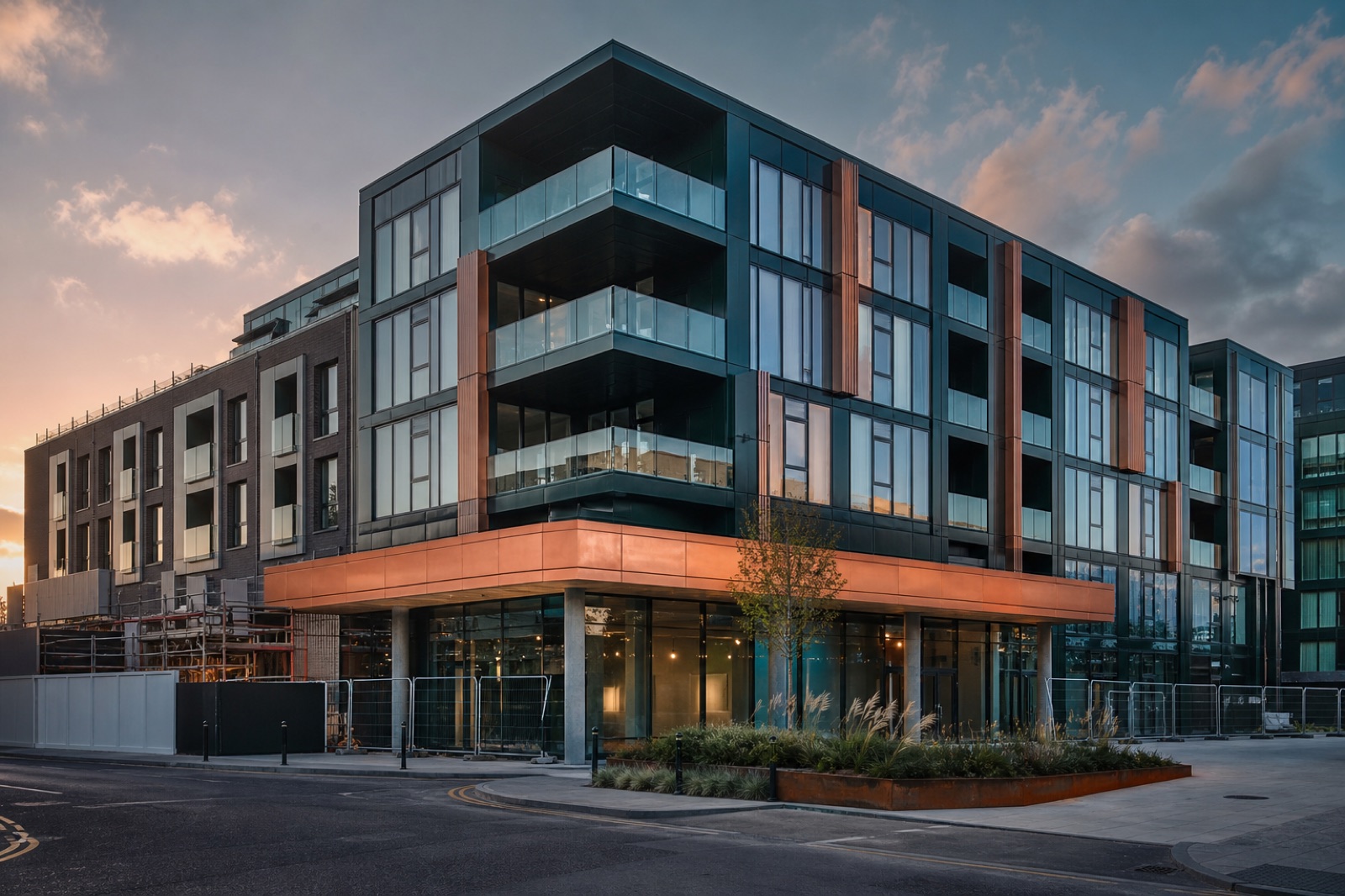
Development exit finance for completed holiday and residential parks
The facility that repays a holiday park development loan at practical completion, funds the sell-down of the lodges and pitches, and carries the park through the stabilisation period until it trades as a settled business. Holiday park finance replaces construction-priced debt with cheaper money once the build risk is gone, and removes the pressure of a maturing development loan while the lodges sell and the park ramps up to a stable income. We arrange and place it with specialist bridging lenders and debt funds active in leisure and park lending.

What is a development exit bridge for a finished holiday park?
Holiday park finance, in the development exit sense, is a bridging loan arranged once a holiday or residential park reaches practical completion, used to repay the development loan and to carry the finished park through its sell-down and stabilisation period. The development facility was priced for construction risk, the risk that the groundworks, the pitch infrastructure and the amenity buildings run over budget or behind programme, or fail to complete. Once the pitches are formed, the services are in and the lodges and static caravans are sited, that risk is gone, but the development loan is often expensive and close to its maturity date. A development exit bridge refinances it onto cheaper terms and buys the operator the months needed to complete the lodge sales and let the park settle into a trading business, rather than forcing a discounted bulk sale to clear a development loan that has run out of road.
On a holiday park the income builds in two ways at once, which is what makes this different from a straight housing sell-down. Lodge and static caravan sales release capital plot by plot as buyers complete on individual units, while the park itself stabilises into a trading business that earns pitch fees, ground rent and site income from the occupied pitches. A residential park homes site governed under the Mobile Homes Act earns pitch fees from residents on a licensed park, and a holiday lodge park earns siting fees and holiday income. The exit facility is sized against the value of the completed park and its unsold pitches and lodges, and it can release equity above the development loan being repaid, so capital is not trapped while the absorption rate works through the remaining units.
DevExit is an arranger and introducer, not a lender. We place holiday park finance with specialist bridging lenders and debt funds that operate in development exit, leisure and park lending across the market. We size the facility on the gross development value of the completed park, structure the interest so it does not erode the operator's cash flow during the sales and stabilisation period, and line up the longer-term exit at the same time, whether that is the pitch sell-down itself or a refinance of the trading park onto investment or trading term debt. All terms are illustrative, subject to principal sign-off, and not an offer of finance.
- Repays the senior development loan once the holiday or residential park reaches practical completion
- Funds the sell-down of lodges and static caravans and the stabilisation of pitch income
- Releases equity above the loan repaid, so capital is not trapped during the sales period
- Sized on gross development value (GDV), not build cost, across the unsold pitches and lodges
- Priced below the development finance it replaces because the build risk is gone
- Placed with specialist bridging lenders and debt funds active in leisure and park lending
Indicative terms
- Gross development value (GDV)Facility sized on the day-one value of the completed park, its unsold lodges and its pitch income
- Loan to value (LTV)Indicatively up to 65 to 75 percent of GDV, often 65 percent on a trading park and up to 75 percent on lodge stock
- Loan amountTypically from 500,000 pounds upward, scaled to the park, not consumer lodge finance of 10,000 to 500,000 pounds
- TermTypically 12 to 18 months, covering the sell-down and stabilisation period
- RateIndicatively a lower rate than the development finance it replaces, priced per month or per year
- RepaymentInterest usually retained or rolled up, with partial repayments as lodges and pitches sell
- SecurityFirst legal charge over the completed park, the unsold units and the trading site
- ExitSell-down of pitches and lodges, then a trading or investment term refinance of the settled park
Indicative only. Terms vary by lender, scheme and borrower and are not an offer of finance.
Who it suits
- Park operators marketing the final unsold lodges and static caravans on a completed park
- Developers whose senior development loan is maturing before the pitch sell-down finishes
- Operators carrying a finished park through stabilisation into a trading business
- Borrowers refinancing off expensive construction-priced development finance on a leisure scheme
- Residential park homes developers awaiting pitch take-up on a licensed park
Discuss your scheme
A view on fundability within one working day.
How sales-period funding works on a completed lodge park
Confirm practical completion
We confirm the pitches are formed, the services and amenities are in, the park is licensed, and we value the completed park, its unsold lodges and its pitch income on a gross development value basis rather than on build cost.
Repay the senior debt
We arrange a finished-scheme bridge that repays the senior development loan in full, usually at a lower rate, and term it to cover the sell-down of the lodges and the stabilisation of the park.
Sell down and stabilise
The operator completes on the unsold lodges and static caravans while the park settles into a trading business earning pitch fees and ground rent, without the pressure of a maturing development loan, and surplus equity can fund the next phase.
Repay on sales or refinance
The facility is repaid through the sales of the remaining units, with partial redemptions as each lodge completes, or by refinancing the stabilised park onto a trading or investment term loan.
Criteria for a finished-scheme bridge on a licensed park
Park lenders are most comfortable once a holiday or residential park has reached practical completion, because the construction risk that drove the development finance has been removed. They want sight of the practical completion evidence, the site licence and the planning consent for the use, confirmation that a residential park homes site complies with the Mobile Homes Act, a valuation of the completed park and its unsold units, and a credible plan that covers both the lodge sell-down and the stabilisation of pitch income. They will look at the sales rate and absorption on the pitches sold so far, the pitch fees and ground rent the occupied pitches produce, and how the operator runs the trading side, because the exit is part sales and part trading refinance. They assess the operator's experience, but they are underwriting a finished, licensed, income-producing park rather than years of trading history, so an operator with a sound scheme and a sound sell-down is fundable. Lenders are stricter on the exit than on the borrower, because a bridge with no realistic sell-down or refinance simply moves the problem along. We package the completion evidence, the licence and planning position, the pitch sales evidence and the stabilisation model so the case is presented at its strongest.
How much exit funding you can raise against unsold lodges and pitches
Holiday park finance in the development exit sense is sized against the gross development value of the completed park, indicatively up to 65 to 75 percent of GDV, often nearer 65 percent against the trading park as a going concern and up to 75 percent against saleable lodge and static caravan stock. That is often higher leverage than the development loan provided, because the park is now finished and valued on completion rather than on cost. The headroom does two things: it repays the senior debt in full, and it can release surplus equity for the operator to put into the next phase or the next site. As each lodge sells and each pitch is taken up, a partial repayment reduces the balance, so the loan to value falls through the sell-down and the cost reduces with it. This is commercial park lending scaled to the scheme, not the consumer hire purchase or lodge finance a buyer uses to fund a single unit at an advertised APR. The facility runs for the sales and stabilisation period, typically twelve to eighteen months, and the interest is usually retained or rolled up so monthly debt service does not consume the operator's cash flow before the units sell. We model the loan against GDV, the pitch income, the sales rate and the all-in cost over the expected term before approaching lenders. All bands are illustrative, vary by lender and scheme, are subject to principal sign-off, and are not an offer.
What the exit facility costs across the sell-down and stabilisation
The point of the exit facility is the saving: refinancing off development finance priced for construction risk onto a finished-scheme bridge priced for a completed park usually cuts the monthly cost materially, while removing the maturity pressure that forces a discount on the remaining lodges. Expect a lender arrangement fee, indicatively around 1 to 2 percent of the loan, a valuation of the completed park and its unsold stock, legal costs for both sides, and often an exit fee charged on redemption. The largest cost lever is time, so a strong sales rate and a quick absorption of the pitches costs a fraction of a facility that drifts for the full term. Because the interest is usually rolled up rather than serviced, the headline rate matters less than the all-in cost across the sell-down and stabilisation, and partial repayments as lodges and pitches sell bring the balance and the interest down as you go. We disclose our arranger fee in writing, quote the all-in cost over the expected term rather than the headline margin, and never claim an exclusive panel or a fixed tie to any lender. The figures are indicative and not an offer of finance.
Park sell-down funding against development debt and a trading refinance
Park sell-down funding sits between the development loan that built the park and the long-term debt that holds it once it trades. Development finance is the wrong tool once the park is complete, because it is priced for construction risk that no longer exists, which is exactly why replacing it with a finished-scheme bridge lowers the cost. A trading or investment term loan is the cheapest money, but it only suits a park that has stabilised into a settled business with proven pitch fees, ground rent and occupancy, so it is not available on day one of the sell-down. The development exit bridge is the structure built for that gap: value-led, sized on the unsold lodges and the stabilising pitch income, and repaid as the units sell and the park settles. The exit is usually a blend, with lodge and static caravan sales repaying part of the balance while the remaining trading park refinances onto a term or investment refinance once the income is proven. Compared with a general bridging loan, this facility is underwritten on a clear, near-term sell-down and a stabilising trading business rather than just the value of the security. We map the route so the park is on the right debt for what it is about to do.
Holiday and residential parks: common questions
How do I refinance a newly completed holiday park before all the pitches and lodges are sold?
We arrange a development exit bridge, secured by a first legal charge over the completed park, that repays the senior development loan in full at practical completion and runs through the sell-down and stabilisation period, typically twelve to eighteen months. It is sized on the gross development value of the finished park and its unsold lodges and pitches, usually at a lower rate than the development finance it replaces. It is repaid as the lodges and pitches sell, with partial redemptions as each unit completes, and then by a trading or investment refinance of the settled park. All terms are illustrative and subject to principal sign-off.
What development exit finance is available to bridge the sell-down of a holiday or residential park?
Development exit finance for a completed park is value-led bridging that repays the development loan at practical completion and funds the sell-down of the lodges and pitches while the park stabilises into a trading business. It is sized on the day-one value of the finished park, indicatively up to 65 to 75 percent of gross development value, and can release equity above the loan being repaid. We place it with specialist bridging lenders and debt funds active in leisure and park lending, and we line up the trading or investment refinance as the planned exit. The figures are indicative and not an offer of finance.
Can I get bridging finance against a completed lodge park while it stabilises into a trading business?
Yes. A finished-scheme bridge is built for exactly this window, when the lodge park is complete and licensed but has not yet settled into a stable trading income. It repays the maturing development loan, removes the pressure that forces a discounted bulk sale, and gives the park time to sell the remaining lodges and build occupancy and pitch income to the level a trading lender will refinance. The interest is usually retained or rolled up so it does not consume cash flow during stabilisation. We line up the trading refinance as the exit, so the bridge has a defined destination.
What loan-to-value can I get when refinancing a holiday park development, 65 or 75 percent LTV?
Indicatively up to 65 to 75 percent of gross development value, and the band depends on what the lender is securing against. A lender pricing the trading park as a going concern often sizes nearer 65 percent of value, while a facility against saleable lodge and static caravan stock can reach up to 75 percent. As lodges sell and pitches are taken up, partial repayments reduce the balance, so the loan to value falls through the sell-down. The bands are illustrative, vary by lender and scheme, and are subject to principal sign-off.
How do I move from development finance to a trading or investment refinance on a residential park?
The move is rarely a single step on a residential park, because a term lender wants proven, stabilised income before it prices its longest money. A development exit bridge carries the park across that gap: it repays the development finance at practical completion, funds the pitch sell-down, and gives the licensed park time to build settled pitch fees and ground rent under the Mobile Homes Act. Once the income is proven, the park refinances onto a trading or investment term loan, which we arrange as the planned exit from the outset. All terms are illustrative and subject to principal sign-off.
What lenders fund holiday and residential park developers during the sales and stabilisation period?
We place this finance with specialist bridging lenders and debt funds that operate in development exit, leisure and park lending across the market, rather than a fixed panel. These are commercial lenders funding the operator and the trading park at scale, which is a different market from the consumer lodge and static caravan finance a buyer uses to fund a single unit. We are an arranger and introducer, not a lender, so we approach the lenders whose appetite fits the park, the sell-down and the planned refinance, and we do not claim an exclusive tie to any one of them. The figures are indicative and not an offer of finance.
Funding a completed holiday and residential parks scheme?
Send us the scheme and where it has reached, and we will come back with a view on fundability and likely terms within one working day.