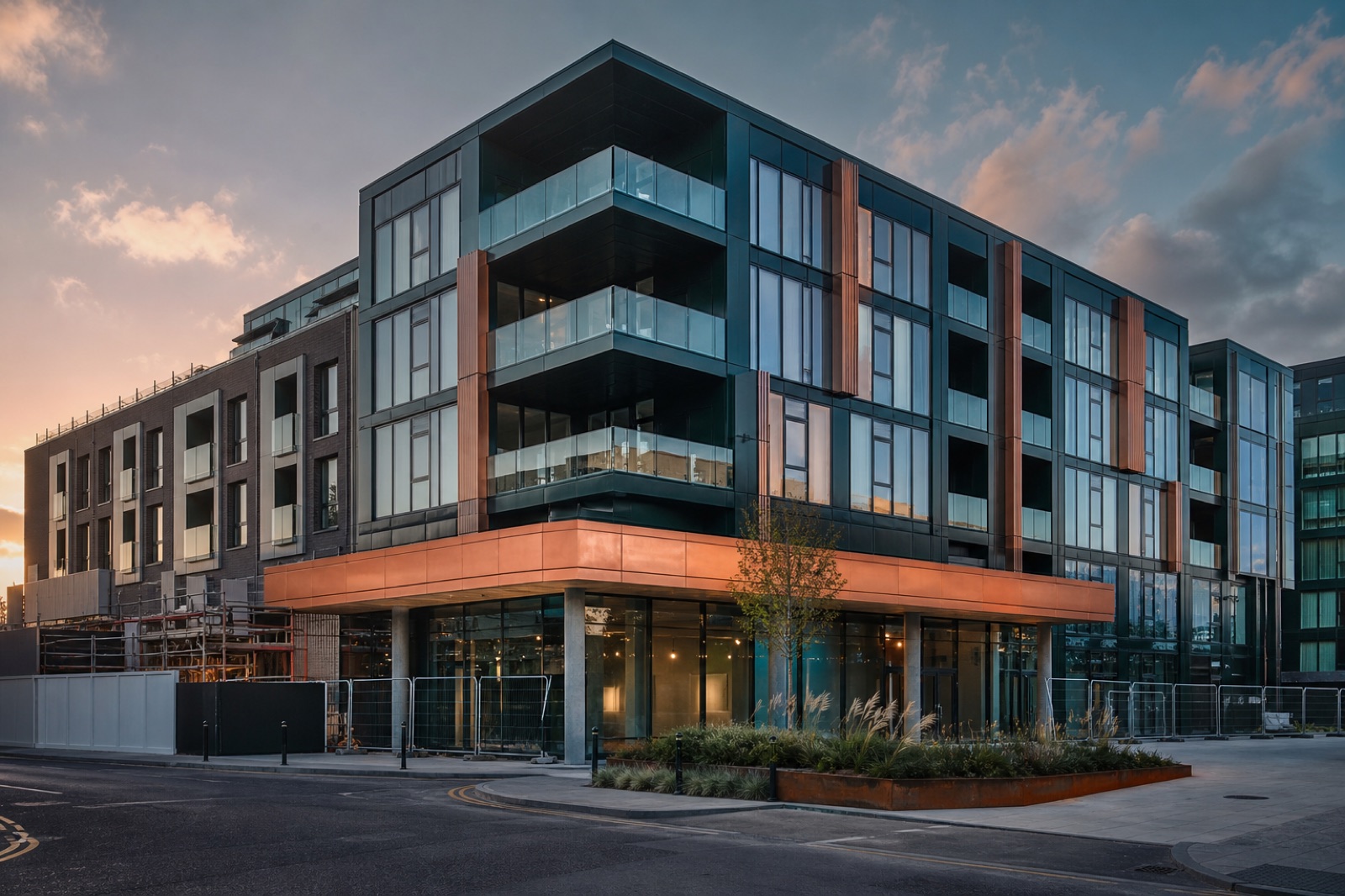
Development exit finance for build-to-rent schemes
The facility that repays a build to rent development loan at practical completion, then carries the completed block through its lease-up and stabilisation period to a stabilised investment refinance or an institutional sale. We arrange and place the exit leg that competitor lenders rarely cover, so a finished BTR scheme is not left on construction-priced debt while it fills with tenants and reaches the income an investment lender wants to see.

What is build-to-rent exit funding?
Build to rent development finance is the funding that constructs a purpose-built rental block, drawn in staged drawdowns against land acquisition and build costs and priced for construction risk. Build-to-rent exit funding is the next leg: a development exit bridge arranged once the scheme reaches practical completion, used to repay that development facility and hold the finished block while it leases up. The build risk is gone, so the exit facility is cheaper than the development loan it replaces, and it is sized on the gross development value (GDV) of the completed block rather than on its build cost. This is the post-completion stage that most BTR lender pages stop short of, because they fund the construction and then hand the borrower back to the market.
The reason build-to-rent needs a dedicated exit is the financial model. A build-to-sell scheme recoups its cost from unit sales over a defined sales period, so a value-led bridge holds it while the units sell. A build-to-rent scheme, single-family or multi-family, recoups its cost from recurring long-term rental income, so it has to pass through a lease-up period and reach a stabilisation period before it produces the stabilised value and net interest cover that an investment lender or an institutional buyer will underwrite. During that window the BTR development loan is the wrong debt: it is at or near maturity and priced for a risk that no longer exists. A finished-scheme bridge carries the block from practical completion to a stabilised asset, absorbing void periods and the income ramp without the pressure of a maturing facility.
We are arrangers, not a lender. We place build to rent development finance exits with the specialist bridging lenders and debt funds that operate in development exit and investment-grade residential, and we line up the long-term exit at the same time, whether that is a refinance onto a commercial investment mortgage, a buy-to-let mortgage on a smaller single-family BTR portfolio, or an institutional sale of the stabilised block to a private rented sector (PRS) buyer. The asset is never left on the development facility longer than it needs, and it is never pushed toward an investment refinance before the rental income supports it. All terms are illustrative, subject to principal sign-off, and not an offer of finance.
- Repays the build to rent development loan at practical completion
- Sized on gross development value (GDV), not build cost, indicatively up to 65 to 75 percent of GDV
- Carries the block through the lease-up and stabilisation period
- Absorbs void periods while rental income ramps to a stabilised level
- Secured by a first charge over the completed purpose-built rental block
- Exits to a stabilised investment refinance or an institutional sale
Indicative terms
- Loan sizeIndicatively 1 million to 35 million pounds, larger on a strong block
- Loan to GDVIndicatively up to 65 to 75 percent of GDV (LTGDV) on the completed block
- Term18 to 36 months, covering lease-up and stabilisation
- RateIndicatively below the BTR development loan it replaces, priced per year
- RepaymentInterest retained or rolled while rent ramps, part-serviced as income builds
- SecurityFirst legal charge over the completed build-to-rent block
- Key testsPractical completion, lease-up trajectory, minimum stabilised ICR around 1.25x
- ExitStabilised investment refinance onto a term loan, or an institutional sale
Indicative only. Terms vary by lender, scheme and borrower and are not an offer of finance.
Who it suits
- Professional developers whose BTR development loan is maturing before the block is let
- Landlords holding a completed single-family or multi-family BTR scheme through lease-up
- Developers of 6 or more units who need a multi-unit scheme carried to stabilised income
- Owners refinancing off construction-priced debt onto cheaper sales-period funding
- Borrowers planning an institutional sale of a stabilised PRS block to a fund
Discuss your scheme
A view on fundability within one working day.
How a BTR development exit bridge works step by step
Confirm practical completion
We confirm practical completion, the warranties and building control sign-off, and value the finished block on its gross development value rather than its build cost.
Repay the development facility
We arrange a development exit bridge that repays the maturing BTR development loan, usually at a lower rate, and term it across the lease-up and stabilisation period.
Carry the block through lease-up
The block fills with tenants while interest is retained or rolled, so the rising rental income is not consumed by debt service during the early void-heavy months.
Exit to a stabilised refinance or sale
Once the block hits a stabilised ICR, the bridge is repaid by an investment term loan we arrange, or by an institutional sale of the stabilised asset.
Criteria for a finished-scheme bridge on a completed BTR block
Build-to-rent exit lenders are most comfortable once the scheme has reached practical completion, because the construction risk that drove the development finance has been removed. They want sight of the completion certificate, the building warranties, building control sign-off, and confirmation that any Section 106 obligations and the planning permission are discharged, alongside a valuation of the finished block on its gross development value. The case then turns on the lease-up: the current occupancy, the letting trajectory, achievable market rents, realistic void periods, and the path to a stabilised net interest cover ratio, with most lenders looking for a minimum stabilised ICR around 1.25x before they will price the exit refinance. They underwrite the developer's experience and any contractor and management arrangements, but on a finished, income-producing asset they weight the block and the credibility of the lease-up more heavily than years of trading. We confirm and document the stabilised exit before the facility draws, so the finished-scheme bridge has a defined destination rather than an open end.
Leverage on the exit facility through the lease-up period
The exit facility on a BTR block is sized against the value of the completed scheme, indicatively up to 65 to 75 percent of gross development value (GDV), which is often higher than the development loan being repaid because the block is now finished and valued on completion rather than against loan to cost (LTC), which on a BTR development can run up to around 80 percent of cost. That headroom can release surplus equity for the next scheme. During lease-up the block is not yet at full rental income, so interest is usually retained or rolled, then part-serviced as occupancy and income build toward a stabilised value. The destination is a stabilised investment refinance: once the block is let to a stabilised ICR, the net investment value supports a long-term commercial investment mortgage or, on a smaller single-family BTR portfolio, a buy-to-let mortgage, at the keenest pricing. Index-linked rental income on some BTR leases helps the stabilised cover hold up over the term. We model the lease-up, the income at each stage, the stabilised value and the term loan it leads to before approaching lenders. All bands are illustrative, vary by lender and scheme, are subject to principal sign-off, and are not an offer.
What lease-up funding costs on a BTR scheme
The point of moving a completed block onto lease-up funding is the saving: refinancing off a build to rent development loan priced for construction risk onto a development exit bridge priced for a finished, investment-grade residential asset usually cuts the cost materially, while removing the maturity pressure that would otherwise force a discounted sale before the block has stabilised. Expect a lender arrangement fee, indicatively around 1 to 2 percent of the loan, a valuation reflecting the lease-up position, and legal costs for both sides. The largest cost lever is time, because the facility is held across the lease-up and stabilisation period, so a block that fills quickly in a strong rental market reaches the cheaper term loan or the sale sooner. Because interest is often retained or rolled rather than fully serviced, the all-in cost across the expected term matters more than the headline rate. We disclose our broker fee in writing, quote the all-in cost to the stabilised exit rather than the headline margin, and never claim an exclusive panel or fabricate lender numbers. The figures are indicative and not an offer of finance.
The BTR stabilisation route against development finance and a term loan
The build-to-rent exit leg sits between two facilities that cannot do its job. Build to rent development finance, sometimes called build to let development finance, is the wrong debt once the scaffolding comes down, because it is priced for construction risk that no longer exists and is at or near maturity, which is exactly why repaying it with an exit bridge lowers the cost. A long-term commercial investment mortgage is the cheapest money but is not yet available, because an investment lender wants a stabilised asset with a proven stabilised ICR before it refinances, and a freshly completed block is still leasing up. The exit bridge carries the block across that gap, from a construction-to-retention or retention finance position into a stabilised investment refinance or an institutional sale to a private rented sector buyer. Compared with a build-to-sell scheme, where sales-period funding holds the asset while units sell, a BTR block recoups its cost from recurring rental income, so the exit is income-led and termed for the longer lease-up rather than a quicker sell-down. We map the route so the block is on the right debt for what it is about to do.
Build-to-rent development exit finance: common questions
What is build to rent development finance and how does it differ from build-to-sell finance?
Build to rent development finance funds the construction of a purpose-built rental block in staged drawdowns against land and build costs. It differs from build-to-sell development finance in how the cost is recouped: a build-to-sell scheme is repaid from unit sales over a sales period, while a BTR scheme is repaid from recurring long-term rental income, so it must pass through a lease-up and stabilisation period before it produces stabilised income. That is why a BTR scheme needs a dedicated exit facility to carry it from practical completion to a stabilised refinance, rather than just a sales-period bridge.
How do you refinance a completed BTR block off development finance after practical completion?
Once the block reaches practical completion, we arrange a development exit bridge secured by a first charge and sized on the gross development value of the finished scheme rather than its build cost. The bridge repays the maturing development loan, usually at a lower rate, and runs across the lease-up and stabilisation period. It is then repaid by a stabilised investment refinance onto a long-term commercial investment mortgage or buy-to-let term loan, or by an institutional sale once the block is let and stabilised.
What is development exit finance for build to rent and when should you use it during lease-up?
Development exit finance for build to rent is short-dated debt arranged at practical completion to repay the BTR development loan and hold the finished block through lease-up. You use it the moment the build is complete and the development facility is at or near maturity but the block is not yet let to a stabilised level. It removes the maturity pressure, lowers the cost of capital because the construction risk is gone, and buys the time the block needs to reach the income an investment lender or buyer will underwrite.
How much can you borrow against a BTR scheme and what LTGDV, LTC and stabilised ICR do lenders require?
Indicatively up to 65 to 75 percent of gross development value (loan to GDV) on the exit facility for the completed block, which is often more than the development loan being repaid. On the development facility itself, loan to cost (LTC) can run up to around 80 percent. Most lenders look for a minimum stabilised interest cover ratio of around 1.25x before they will price the investment refinance. Loan sizes indicatively run from 1 million to 35 million pounds. The figures are illustrative, vary by lender and scheme, and are subject to principal sign-off.
How does BTR finance bridge the lease-up and stabilisation period before an investment refinance or sale?
The exit bridge is termed for 18 to 36 months to cover the lease-up and stabilisation period. During that window the block fills with tenants and absorbs early void periods, while interest is retained or rolled so the rising rental income is not consumed by debt service. As occupancy builds, the income approaches a stabilised level and the net investment value rises, until the block meets the stabilised ICR an investment lender or institutional buyer requires. At that point the bridge is repaid by a term refinance or an institutional sale of the stabilised asset.
Which UK lenders offer build to rent development and exit finance, and what are their loan sizes and terms?
Specialist real estate lenders, challenger banks and private debt funds active in this market, alongside dedicated development funders, fund build to rent development and exit finance. Loan sizes indicatively run from around 1 million to 35 million pounds, with terms of 18 to 36 months on the exit leg and minimum stabilised ICRs around 1.25x. We are arrangers, not a lender, and we place each case with the lender whose criteria fit the block. We do not quote named lender rates or claim a fixed panel, and all figures are indicative and not an offer of finance.
Funding a completed build-to-rent development exit finance scheme?
Send us the scheme and where it has reached, and we will come back with a view on fundability and likely terms within one working day.